The Era of Growth by Burning Capital Is Over
An entire generation of growth leaders only knows one motion: scale by lighting capital on fire. The market that rewarded it is gone. What replaces it is a system — one where paid and owned make each other cheaper, and nothing owns you.
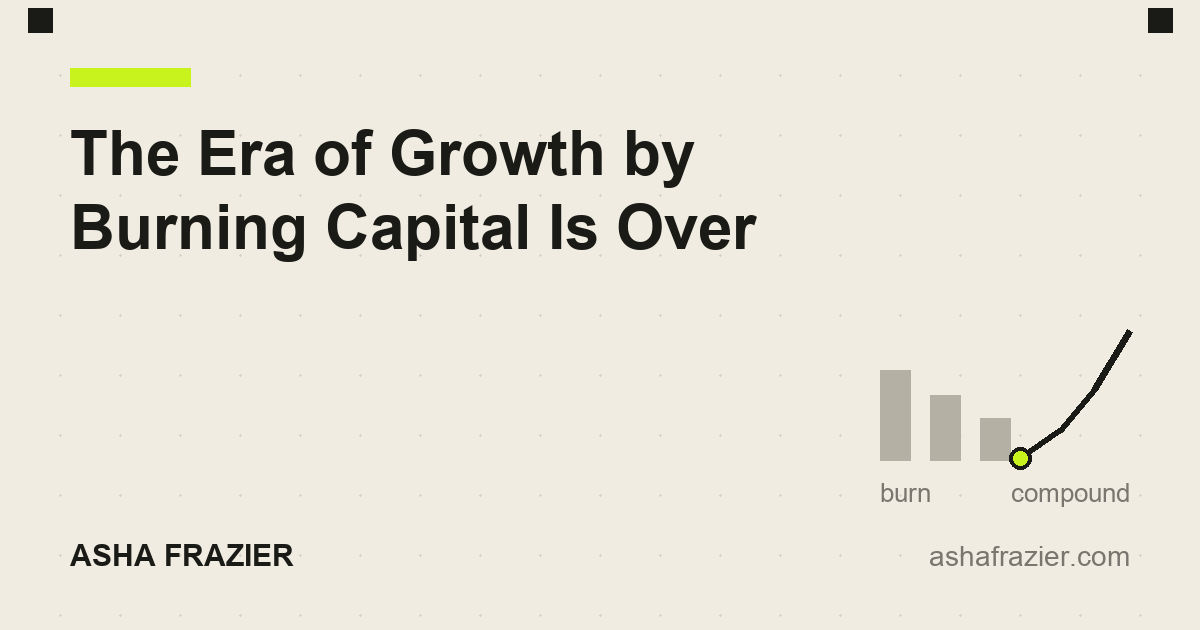
Boards stopped clapping for growth-at-any-cost. Somewhere between the ZIRP hangover and the third round of layoffs, the question changed from "how fast are you growing?" to "what does a dollar of growth cost you, and would it survive you cutting the budget?" An entire generation of growth leaders is being exposed by that question. They only know one motion — scale by lighting capital on fire — and the market that rewarded it is gone.
I didn't come to capital efficiency as a rebrand. I learned it in a seat that gave me no other option.
When I joined Cubii as the first hire, the company was losing $40K a month. There was no war chest to burn through while we "found the model." The model had to pay for itself, immediately, or there would be no company. We turned it profitable in about 60 days — not with a bigger budget, but by finding the real customer in the data, compressing the purchase cycle, and building an email engine that turned a list into a revenue switch. That company went on to a $100M exit. The discipline wasn't a constraint on the growth. It was the growth.
Here's what that experience taught me that the burn-era playbook never teaches: efficiency isn't the opposite of aggression. The most aggressive thing you can do is know your unit economics cold, because then you can spend when everyone else is frozen.
The false choice that keeps CMOs mediocre
The industry keeps forcing a choice: performance people who can spend, or brand-and-owned people who can compound. Pick a lane, hire two leaders, hope they don't fight over budget.
I've spent my career refusing that choice, at both extremes of it.
At The RealReal, I scaled paid spend from $300K to over $2M a month and held a 7x ROAS while doing it — a paid channel driving $100M+ a year in attributed revenue, with CAC down 40%. That is not "paid as a necessary evil." That's paid run as a precision instrument at public-company scale.
At CodaPet, the mix is inverted: most demand arrives through channels the company owns — local presence, organic, owned lists — built from scratch in a category nobody searches for until the worst week of their year. A lean team, no agency layer, and an engine that keeps producing after the spend stops.
Same operator. Opposite mixes. Because the point was never paid versus owned — that's a channel argument, and channel arguments are for vendors. The point is the system: paid feeds the data, audiences, and lists that make owned channels compound; owned channels lower blended acquisition cost so paid can push harder at the same discipline. Each engine makes the other cheaper. When they're built right, neither one owns you.
The real enemy is dependence
Strip the jargon and every failed growth story I've walked into is a dependence story. Dependent on one channel that changed its algorithm. Dependent on an agency whose reporting nobody could reconcile with the bank account. Dependent on paid traffic that stopped the moment the spend stopped. Dependent on a founder who is personally the entire sales motion.
Burning capital doesn't just waste money — it buys dependence. It lets you skip the unglamorous work of building demand that belongs to you, right up until the money slows down and you discover the business has no muscles of its own.
The alternative isn't spending less. It's building the machine so that spend is a choice, not a life-support system:
- Unit economics as the operating system, not a quarterly report. I've cut CAC between 40% and 90% at companies across my career, and it starts the same way every time: honest attribution, a kill list for the bottom of the spend, and the discipline to measure what a customer is worth before arguing about creative.
- Owned assets treated as revenue infrastructure — lists, local presence, content that ranks, data you control — assets that keep producing after the invoice stops.
- Paid mastery held in-house as a core competence, so the ceiling on efficient spend keeps rising instead of renting that judgment by the month.
What this era actually rewards
The companies that win the next decade won't be the ones that never spend. They'll be the ones where a dollar in produces a measurable, repeatable, improving return — and where turning the paid dial down is a strategic option instead of an existential event.
That's a systems problem, and it's an ownership problem. It can't be solved by a dashboard, an agency, or one more channel hire. Somebody senior has to build the machine, wire the engines together, and be accountable for what comes out the other end in revenue.
The burn era let a lot of people skip that work. This era won't.
Growth notes, occasionally.
What I'm seeing in the numbers across engagements — sent when there's something worth saying, not on a schedule. Reply to unsubscribe; no sequence, no spam.